

The economic geography of South India is currently witnessing a seismic paradigm shift, driven by the emergence of the Hosur–Chennai industrial axis as a primary engine of national growth. This corridor, a vital component of the broader Chennai-Bengaluru Industrial Corridor (CBIC), represents a convergence of legacy manufacturing prowess and future-ready technological innovation. Historically, the region was characterised by disparate industrial clusters—Chennai’s automotive dominance in the east and Bengaluru’s technological dynamism in the west. However, the systematic integration of these nodes, facilitated by massive infrastructure projects and the entry of organised industrial developers, has catalysed a seamless supply chain ecosystem.
A Macroeconomic Powerhouse in the Making
Tamil Nadu has established itself as a national leader in industrial expansion, contributing nearly 10% to India’s national GDP. As the second-largest state economy in India, it has successfully attracted significant foreign direct investment (FDI), supported by stable governance and proactive policies. The Hosur–Chennai corridor functions as a strategic developmental pathway designed to optimise the synergy between these significant economic centres. Spanning approximately 560 kilometres, the corridor integrates major urban centres through a network of high-speed highways, dedicated rail links, and advanced ports.
The corridor is a cornerstone of the National Industrial Corridor Development Programme (NICDP), which aims to develop modern industrial centres capable of global competition. The regional perspective plan identifies the CBIC as a platform for fostering growth in sectors such as electronics, automotive manufacturing, and heavy engineering. This geographic triangle—anchored by Chennai, Bengaluru, and Hosur—ensures that the supply chain remains fluid and responsive to both domestic demand and global export requirements.
Infrastructure Catalysts: The Logistics Revolution
The logistical efficiency of this corridor is being redefined by transformative infrastructure projects. At the heart of this revolution is the Bengaluru-Chennai Expressway (NE-7), a 262-kilometre access-controlled greenfield project expected to be fully operational by August 2025. This “transit marvel” is designed to handle high-speed transit, reducing travel time between the two metros from over 5.5 hours to approximately 2.5 to 3 hours.
This improvement in connectivity is a “multiplier” for regional economic activity, leading to a projected 15–20% reduction in overall logistics costs. Furthermore, the expressway acts as a catalyst for the “decentralisation” of warehousing, allowing companies to establish large-scale distribution centres in strategic nodes rather than within congested city limits. Beyond road infrastructure, the region is set to benefit from the proposed Hosur Airport, a greenfield international project spanning approximately 2,000 acres near Bagalur-Berigai. This facility is envisioned as a cargo-heavy hub to complement industrial growth and ease pressure on neighboring major airports.
Complementing these efforts is the development of the Mappedu Multi-Modal Logistics Park (MMLP) near Chennai. This 184-acre facility is designed to handle 7.17 million metric tonnes of cargo over its 45-year concession period. The MMLP will feature container stack yards, bonded warehouses, and specialised cold storage, serving as a focal point for the aggregation and disaggregation of cargo from the region’s automobile and electronics clusters.
The Role of Developers: Building Advanced Ecosystems
One of the most significant shifts in South India’s supply chain landscape is the transition from unorganised, older industrial sheds to sophisticated Grade A industrial and logistics parks. Organised developers are no longer merely providing land; they are building advanced ecosystems that integrate modern infrastructure, policy support, and digital connectivity.
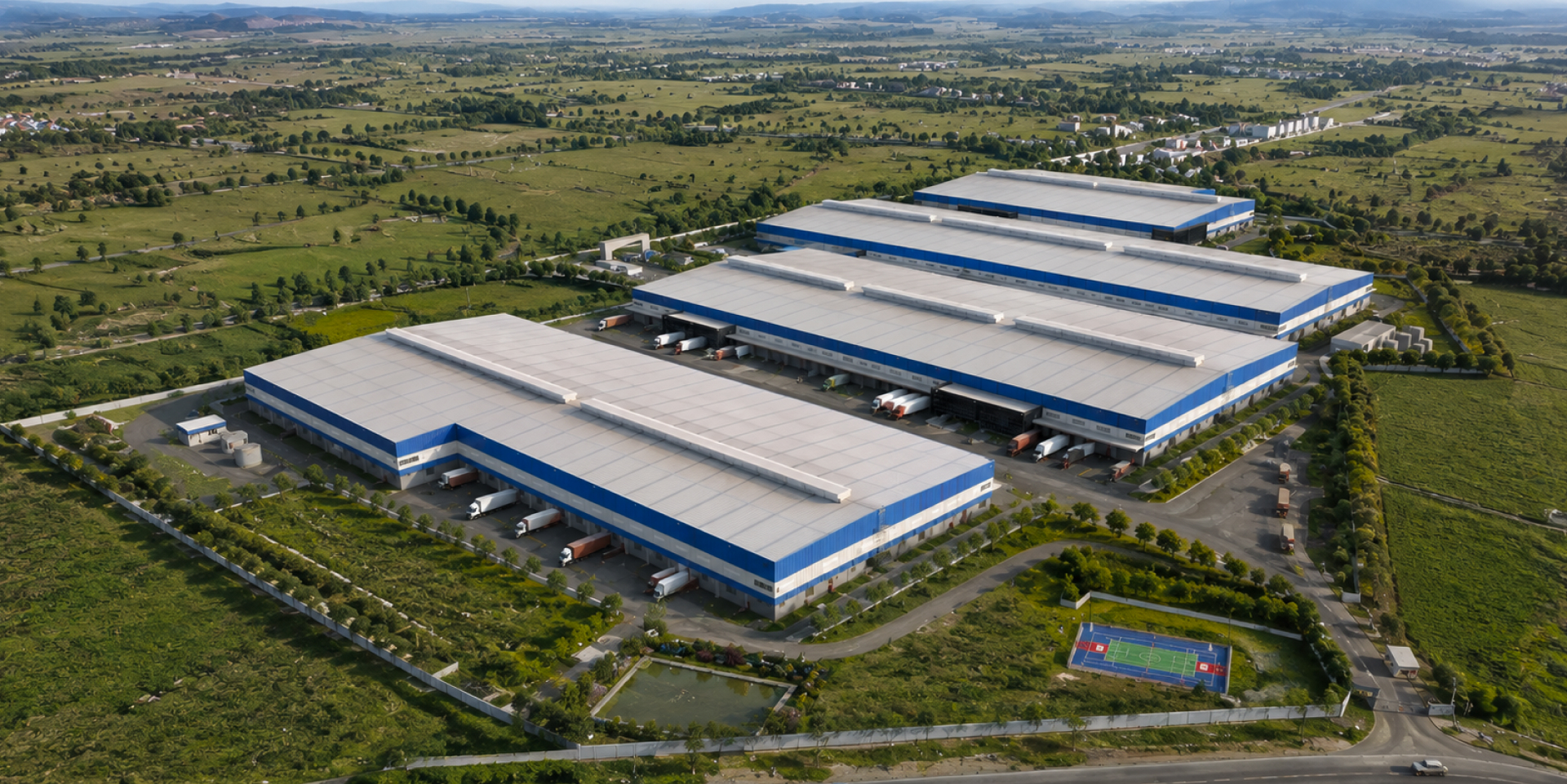
Developers like KSH INFRA are at the forefront of this transformation, moving away from a traditional regulatory role toward a facilitator model that empowers firms to join global value chains. For instance, the newest launch, KSH Hosur Park I, provides 1.26 million sq. ft. of ready Grade A industrial and logistics infrastructure in the heart of the Bengaluru–Hosur belt. These facilities are engineered for operational ease, featuring wide internal roads for smooth truck circulation and ample dock bays designed for simultaneous multi-vehicle loading and unloading.
Technical Excellence and Technical Specifications
- Definition of Grade A Infrastructure
- Built to support advanced manufacturing processes such as automation and robotics
- Focus on precision engineering, durability, and operational efficiency
- Heavy-Duty Flooring (FM2 Standard)
- FM2-compliant flooring ensures high flatness and levelness
- Load-bearing capacity: 5–7 tons per sq. meter
- Enables safe operation of:
- Specialised forklifts
- Heavy robotic assembly lines
- Clear Height (10–12 meters)
- Measured at the eaves
- Supports high-bay racking systems
- Leads to up to 30% increase in space utilisation
- Wide Column Spans
- Minimises internal obstructions
- Allows:
- Flexible facility layout planning
- Smooth movement of goods and machinery
- Efficient assembly line design
- Operational Benefits for Global Occupiers
- Ensures high safety standards
- Supports scalability of operations
- Meets international compliance and quality benchmarks
Sustainability: The New Business Imperative
In today’s global market, “green” performance is a critical differentiator. Modern industrial parks are designed with ESG-compliant infrastructure, including solar-ready roofs and sustainable water systems. Many of these parks adhere to the Industrial Park Rating System (IPRS) 3.0, which introduces data-driven benchmarks for sustainability and digitalisation.
Genuine sustainability measures, such as advanced rainwater harvesting, on-site sewage treatment plants, and energy-efficient lighting, allow businesses to reduce operational costs by up to 25%. For global MNCs, this compliance is critical for annual sustainability reporting and aligns with their net-zero vision.
Sectoral Impacts: Driving Future Growth
The Hosur–Chennai corridor has transitioned into a prominent industrial node hosting a diverse manufacturing landscape. Hosur has evolved into the “EV capital of India,” hosting mega-factories for electric two-wheeler giants alongside traditional automotive leaders. Meanwhile, the Chennai-Oragadam-Sriperumbudur cluster remains the “Detroit of Asia,” where OEMs can find a deep network of suppliers within a 50-kilometre radius.
The corridor is also witnessing a shift toward knowledge-based services. The planned “Hosur Knowledge Corridor” will include R&D centres, Global Capability Centres (GCCs), and a Tidel Park, expected to generate thousands of high-value jobs. This transformation from pure assembly to research-led growth will further cement the region’s status as a comprehensive industrial powerhouse.
Conclusion: A Vision for 2047
Industrial parks are no longer mere land banks; they are strategic instruments of national policy. As South India continues to expand, infrastructure developers like KSH INFRA provide the foundations of trust and innovation required to drive the journey toward the “Viksit Bharat” vision for 2047. The Hosur–Chennai corridor is not just a transport route; it is where smart location meets smarter logistics to build the future of industry.
Head Office
Gokhale Sanchit, Office No. 4, Survey No. 846,
Servants of India Society, Near Marathwada College,
Shivajinagar, Pune, Maharashtra – 411 004 (India)
Call Us: +91 20 2970 4000.
Email: [leasing@kshinfra.com]
Visit: [www.kshinfra.com]
Let’s build the future of industry…together!


