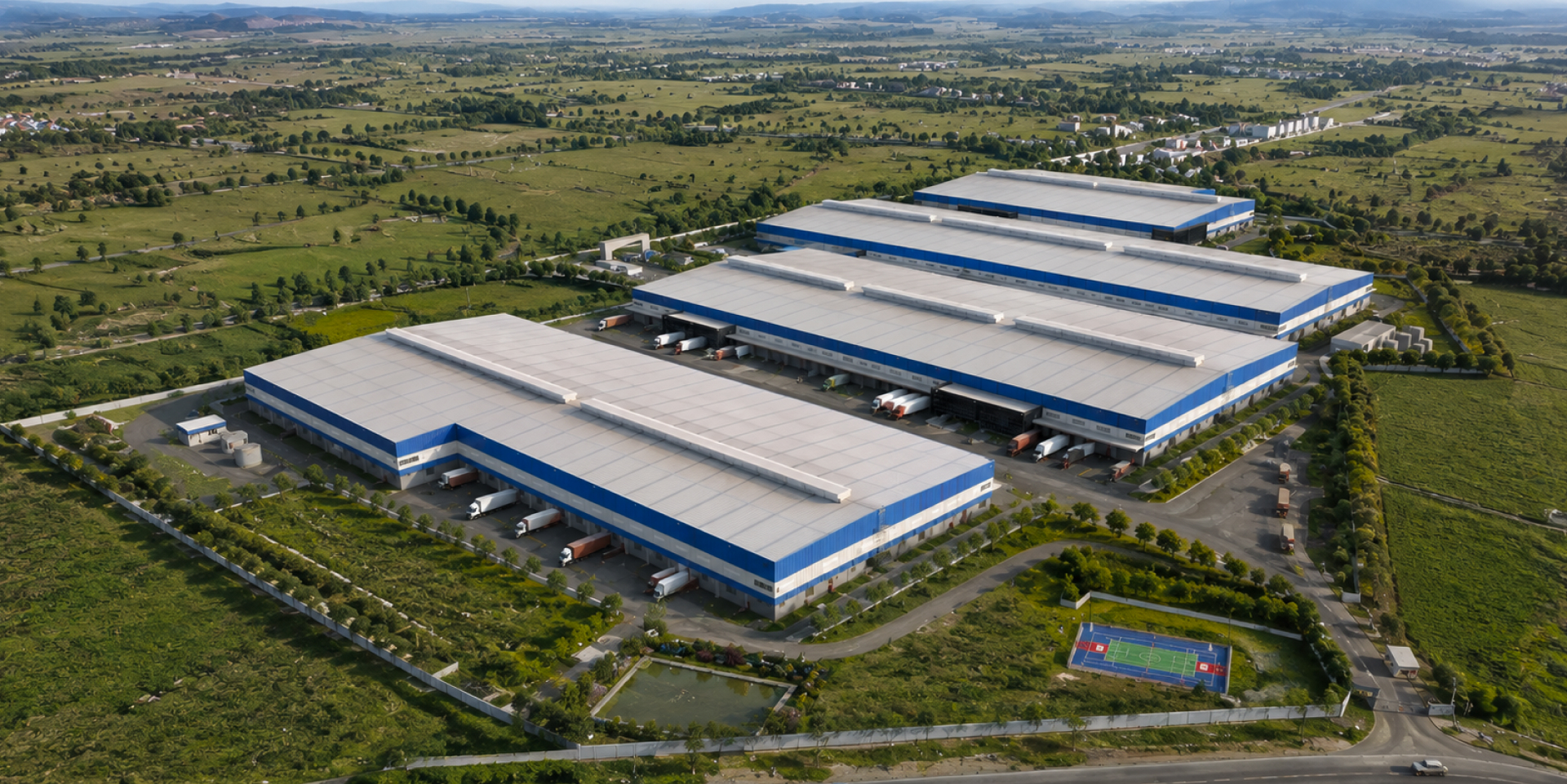


Choosing the right industrial park is the single most consequential decision a contract manufacturer makes in India — bigger than plant layout, bigger than the CapEx-vs-lease call, and often bigger than the machinery decision itself. A well-chosen park compresses time-to-first-production, reduces regulatory risk, and gives you room to scale as your OEM customers grow. A poorly chosen park quietly bleeds you through power failures, effluent penalties, missed subsidies, and stalled expansions. This checklist covers the 12 non-negotiables to evaluate before you sign a lease or buy a plot for a contract manufacturing operation in India.
The checklist is written for founders, project heads, and MDs at electronics EMS players, automotive Tier-2 and Tier-3 suppliers, engineering job-shops, pharma contract manufacturers, and MSME contract producers evaluating parks in Pune, Talegaon, Hosur, Chennai, Bangalore, and other manufacturing corridors. It reflects how KSH INFRA — which operates Grade A industrial parks in each of those five corridors — evaluates the same criteria when it plans a new campus. The framework applies whether you are shortlisting a KSH INFRA park or any other developer’s.
Why Park Selection Matters More for Contract Manufacturers
Contract manufacturers operate on tighter margins and longer commitments than most other industrial tenants. Their customers often evaluate manufacturing facilities as part of the supplier qualification process. As production requirements evolve, businesses need industrial infrastructure that supports operational efficiency, scalability, and future expansion. Their growth is often driven by customer demand, which means the industrial park must be able to accommodate two or three times the current capacity without requiring a relocation.
The park is not just real estate. It is a production system boundary.
The 12-Point Park-Selection Checklist
1. Location Fit With Your Customer & Supplier Base
The single biggest driver of contract manufacturing park selection is proximity to your anchor customer. If you supply Tata Motors, Bajaj, or Mahindra, the Chakan-Ranjangaon belt near Pune is not just a preference—it is a non-negotiable business requirement. If your customer operates within the Apple, Foxconn, or Pegatron ecosystem, Sriperumbudur or Oragadam in Chennai becomes the logical manufacturing base. Similarly, if you supply Ather, Ola, or TVS in the EV sector, the Hosur-Bengaluru-Krishnagiri corridor is not simply an option; it is essential to meeting production, logistics, and supply chain expectations.
Map your top three customers first, then identify the industrial corridors that best support them. Do not reverse the order.
2. Sanctioned Power Load & Supply Reliability
Ask the developer about the park’s total sanctioned industrial power capacity, the maximum power allocation available per tenant, and the historical reliability of the utility network serving the park. High-quality Grade A Industrial and Logistics Parks are typically supported by dedicated high-voltage power infrastructure, scalable power allocations to meet varying operational requirements, and centralized backup systems that help maintain business continuity while reducing the need for individual tenants to invest in separate backup infrastructure.
When evaluating a park, verify three key factors: whether sufficient sanctioned power is available to support future expansion, the frequency of power interruptions, and whether backup power is provided as a shared park-level utility or must be installed independently by each occupier.
3. Land Use Zoning & Permitted Activities
Confirm the park is zoned for your specific manufacturing activity. An electronics-friendly park may not permit chemical processes. A general engineering park may not allow pharma formulation. Ask for the approved industry list under the park’s environmental clearance, and check whether your NIC code is included.
If you are near the boundary of permitted activities, get it in writing before signing.
4. FSI, Bay Flexibility & Expansion Optionality
Contract manufacturers grow in step-changes, not increments. Your customer wins a new SKU, and suddenly you need 40% more floor. The park must accommodate that without a rebuild. Confirm the permitted Floor Space Index (FSI) in the state, the bay modularity of ready-built factory (RBF) units, and — critically — whether adjacent plots or units are available for future expansion.
The single question KSH INFRA hears most often from contract manufacturers on a first site walk-through is a version of this: “If I need to double my footprint in 36 months, what happens?” Whatever park you evaluate, ask it plainly and get the answer in writing.
5. Water Availability & ETP/CETP Capacity
Water is the invisible constraint. Confirm the park’s water source (municipal, industrial supply scheme, borewell allocation), the per-tenant allocation, and the capacity of the Common Effluent Treatment Plant (CETP) or the requirement for a tenant-level Effluent Treatment Plant (ETP).
For pharma, chemicals, textiles, food, and surface-treatment work, CETP capacity is a deal-breaker. Ask for the current utilisation ratio — a CETP running at 90% capacity has no room for a new tenant.
6. Fire Compliance & NBC 2016 Conformity
Every industrial building in India must comply with the National Building Code (NBC) 2016 and state fire norms. Ask for the fire NOC certificate, the sprinkler and hydrant specifications, the fire tender access widths, and the compartmentalisation strategy. For contract manufacturers with automated storage, high-piled goods, or flammable inventory, the fire spec is often what your insurance underwriter reads first.
7. Regulatory Approvals & Single-Window Access
State industrial policy makes or breaks your setup timeline. Confirm whether the park sits inside a state single-window clearance zone — Maharashtra’s MAITRI portal, Tamil Nadu’s Guidance Bureau, or Karnataka’s KUM (K-UDYAMI/eBiz) systems. Ask specifically about:
- Consent to Establish (CTE) and Consent to Operate (CTO) support from the state pollution control board
- Building plan approval turnaround
- Factory licence application timelines
- Environmental Clearance (EC) status of the park itself — parks with valid EC at campus level, which is how KSH INFRA and other institutional developers structure their approvals, save every tenant 6 to 12 months of individual clearance work
8. State Subsidies, PLI Eligibility & MSME Schemes
State industrial policies stack. A contract manufacturer in Hosur can access Tamil Nadu’s structured package incentives, capital subsidies for MSMEs, SGST reimbursement, and — depending on sector — Production Linked Incentive (PLI) benefits from the Government of India. In Karnataka, the New Industrial Policy 2025-30 offers zone-based incentives. Maharashtra’s PSI package differs by taluka.
Ask the developer for a written summary of the subsidy stack applicable to your NIC code at their park. Any serious industrial park operator will have this documented — KSH INFRA, for example, maintains a subsidy summary for each of its five campuses so tenants do not have to reconstruct it from scratch. Vague answers here are a signal.
9. Multi-Modal Connectivity
Contract manufacturing is a logistics business as much as a production business. Evaluate:
- Distance to the nearest national highway (NH) or expressway
- Distance to the port of export (JNPT for Western India, Chennai/Ennore/Kattupalli for Tamil Nadu)
- Distance to the nearest air cargo terminal (relevant for electronics and pharma)
- Rail siding availability inside or adjacent to the park (for heavy engineering, steel, cement)
- Truck turnaround times on typical inbound/outbound routes
A park 25 km from JNPT with clear expressway access will beat a park 12 km away that is stuck behind city traffic.
10. Talent Access & Skilling Ecosystem
Your ability to hire and retain shop-floor talent depends on the park’s location within its labour catchment. Check:
- Availability of Industrial Training Institutes (ITIs) within a 15 km radius
- Existing tenant hiring patterns (are your neighbours poaching from the same pool?)
- Distance to worker housing clusters and public transport links
- State-supported skilling partnerships (NSDC, sector skill councils)
Corridors like Chakan, Hosur, and Sriperumbudur have decades-deep talent pools. Emerging corridors may offer lower cost but require investment in in-house training.
11. Anchor Tenants & Ecosystem Density
Look at who is already in the park. Anchor tenants signal the park has passed rigorous internal audits by large corporates. Neighbouring tenants become potential shared-service partners for logistics, packaging, testing labs, and calibration services. Ecosystem density reduces your operating cost and increases customer confidence.
Ask for the current tenant list and the anchor tenants’ sectoral profile.
12. Developer Track Record & Lease Terms
Finally, evaluate the developer. Institutional-grade industrial park developers — the category KSH INFRA operates in — deliver on published timelines, honour lease escalations transparently, and provide operational support (park management, security, common utilities SLAs) that a plotted MIDC, SIPCOT, or KIADB allocation does not include.
Ask for: number of parks delivered, on-time delivery track record, standard lease tenure options (typically 9-year, 15-year, and 30-year structures for contract manufacturing tenants), CAM charge history over the last three years, and references from existing tenants.
How to Use This Checklist
Score each park you are evaluating on the 12 points, weighted by what matters most to your operation. For most contract manufacturers, points 1 (customer proximity), 2 (power), 7 (approvals), 8 (subsidies), and 12 (developer) carry the highest weight. A park that scores 10/12 on the right criteria will beat a park that scores 12/12 on the wrong ones.
If two parks tie, run a total-cost-of-occupancy comparison over your lease horizon — rent, CAM, subsidy net, power tariff, and expected disruption costs. The lower headline rent is rarely the lower actual cost.
Frequently Asked Questions
What is the difference between a contract manufacturing park and a general industrial park? A contract manufacturing park is not a formal legal category — it is a general industrial park that meets the specific infrastructure, compliance, and connectivity needs of contract producers, particularly around utility reliability, expansion optionality, and multi-tenant ecosystem density.
Which cities are best for contract manufacturing in India? The most active contract manufacturing corridors are Pune (Chakan, Ranjangaon), Talegaon, Hosur, Chennai (Sriperumbudur, Oragadam), and Bangalore (Hoskote, Nelamangala, Bidadi). Each corridor specialises in different verticals — automotive in Chakan and Oragadam, EV in Hosur, electronics in Sriperumbudur, aerospace and EV in Bangalore.
Should a contract manufacturer lease a ready-built factory or buy an industrial plot? Lease a ready-built factory (RBF) when you need speed to production, when your customer contract is under five years, or when you want to preserve capital for machinery. Buy or long-lease a plot when you need custom plant configuration, when you have multi-decade customer commitments, or when you plan multi-phase expansion.
How long does it take to start production in an Indian industrial park? In a Grade A private industrial park with valid environmental clearance and pre-built RBF units, contract manufacturers can begin production in 3–6 months from lease signing. Plotted development with own construction typically takes 12–18 months from allotment to first production.
Are there subsidies available for contract manufacturers in India? Yes. Central-government PLI schemes cover 14 sectors including electronics, automotive components, pharma, and telecom. State industrial policies in Maharashtra, Tamil Nadu, and Karnataka offer capital subsidies, SGST reimbursement, stamp duty concessions, and power tariff subsidies. Eligibility depends on investment size, NIC code, and location tier.
Head Office
Gokhale Sanchit, Office No. 4, Survey No. 846,
Servants of India Society, Near Marathwada College,
Shivajinagar, Pune, Maharashtra – 411 004 (India)
Call Us: +91 20 2970 4000.
Email: [leasing@kshinfra.com]
Visit: [www.kshinfra.com]
Let’s build the future of industry…together!


