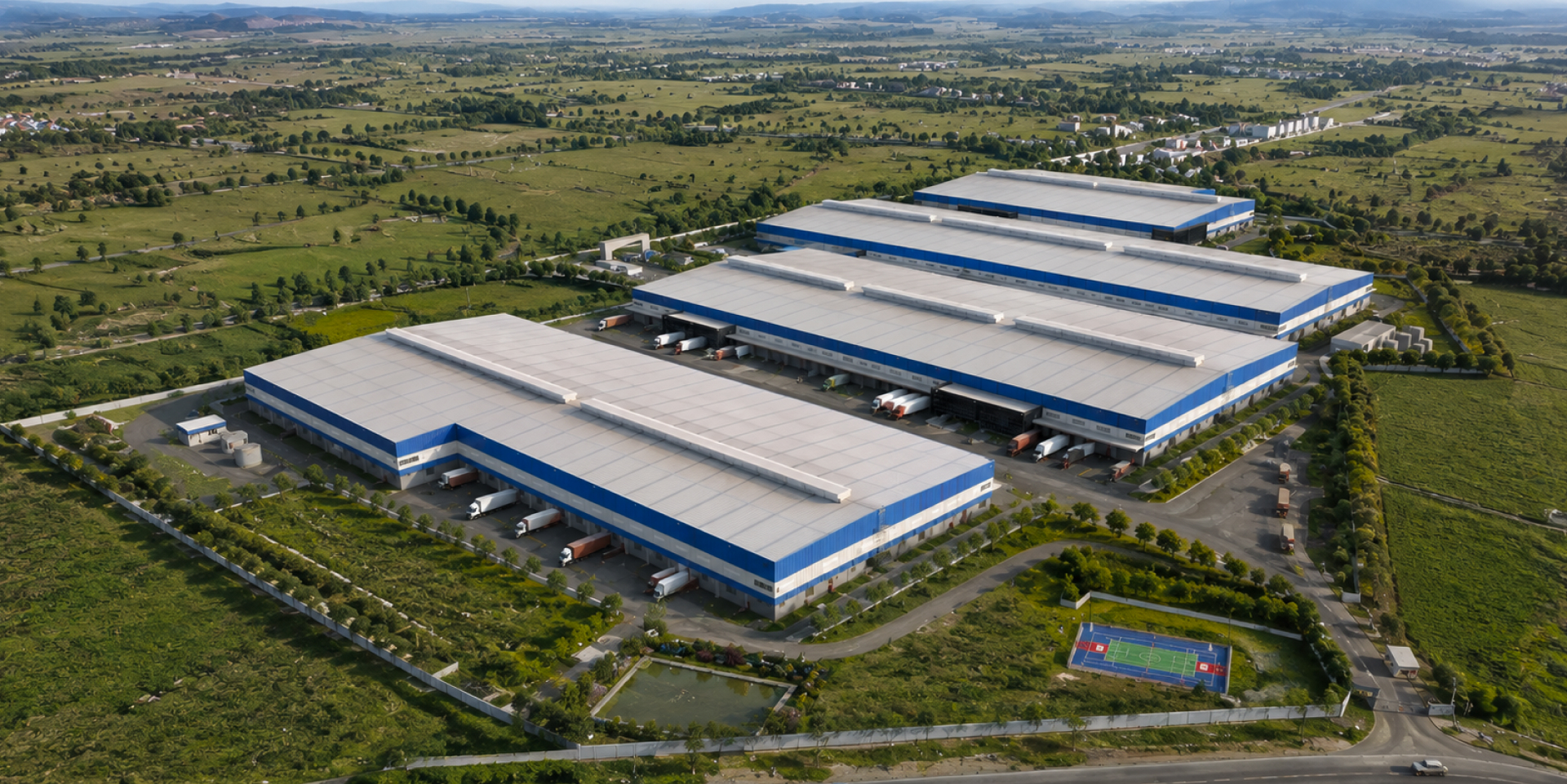


Auditing an industrial park before you sign a lease or buy a plot means systematically verifying the park’s legal title, regulatory approvals, physical infrastructure, commercial terms, and developer track record — before you are financially or contractually committed. It is the single most important pre-signing exercise a manufacturer, investor, or industrial buyer will run, because most of the risks that surface after signing were visible before signing to anyone who knew where to look.
This guide is written for tenants, manufacturers, investors, and industrial buyers evaluating parks in India. It reflects how KSH INFRA — which develops and operates Grade A industrial parks across Pune, Talegaon, Hosur, Chennai, and Bangalore — approaches internal due diligence when it acquires or develops land, and how its tenants approach the same questions from the other side of the table. The framework applies whether you are shortlisting a KSH INFRA park or any other developer’s.
Important note on variability. Industrial real estate regulation in India varies materially by state, by city, by industrial zone (private park, state industrial estate, SEZ), and by the industry you plan to operate. Timelines, approval sequences, subsidies, stamp duty, zoning rules, environmental clearance categories, and Floor Space Index (FSI) all differ. This article outlines the framework and the questions to ask; specific requirements must be verified with the relevant state authority, statutory body, or your legal counsel.
Why an Industrial Park Audit Is Different From a Standard Property Due Diligence
A commercial office or residential real estate diligence focuses on title, encumbrances, and building compliance. An industrial park audit adds four layers that a general real estate lawyer will not always catch: pollution and environmental clearances, factory-specific building code compliance, sector-specific industrial approvals, and the operational reliability of shared park infrastructure (power, water, effluent, fire, roads). Getting the additional layers wrong can stall production for months or trigger regulatory shutdowns after commissioning.
The audit sits across five domains. Work through them in order.
Domain 1 — Land and Title
Before anything else, verify what you are actually leasing or buying.
- Title chain. Request the title deeds and a title-search opinion from an independent lawyer covering at least the last 30 years (industry practice, not a statutory rule). Confirm that the developer has a clear, marketable title to the specific plot or built-up area being offered.
- Land classification and use. Confirm the land is classified for industrial use under the applicable state’s land revenue and town planning laws. Agricultural land that has not been formally converted to non-agricultural (NA) use — the process and terminology differ by state — cannot legally host manufacturing.
- Encumbrances. Obtain a current Encumbrance Certificate from the sub-registrar’s office. Verify there are no unresolved mortgages, court cases, or third-party claims.
- Master plan and zoning. Confirm the plot falls within an industrial zone under the local Development Plan or Master Plan. Some parks span multiple zoning categories; boundaries matter.
- Approvals for the park itself. Institutional developers typically hold layout approvals and, where applicable, environmental clearances for the entire park. KSH INFRA and other institutional operators structure their parks this way so tenants inherit approval benefits. Confirm what park-level approvals exist and what remains for tenant-level filing.
Domain 2 — Regulatory and Environmental Approvals
Indian manufacturing operates under a stack of central and state approvals. Which ones apply depends on your industry, investment size, water and effluent load, and the state.
- Environmental Clearance (EC). Under the Environment Impact Assessment (EIA) Notification, 2006, certain industries and industrial estates require prior EC — Category A projects go to the Central Expert Appraisal Committee, Category B to the State-level committee. Which category applies to your operation depends on the sector and threshold; verify with your environmental consultant.
- Consent to Establish (CTE) and Consent to Operate (CTO). Under the Water (Prevention and Control of Pollution) Act, 1974, and the Air (Prevention and Control of Pollution) Act, 1981, the State Pollution Control Board (SPCB) issues CTE before construction and CTO before operations. Requirements and timelines vary by state.
- Factory Licence. Under the Factories Act, 1948, a factory licence is issued by the state’s Chief Inspector of Factories under the applicable State Factories Rules. Requirements vary.
- Building plan approval and completion / occupancy certificates. Issued by the local planning authority under state building regulations, generally with reference to the National Building Code of India, 2016 (NBC 2016). Fire NOC and lift licences (where applicable) sit alongside.
- Sector-specific approvals. Pharma manufacturers face drug licensing under the Drugs and Cosmetics Act, 1940; food processors face FSSAI licensing; explosives, boilers, and specific chemical operations carry additional approvals.
Domain 3 — Infrastructure and Utilities
Industrial park infrastructure is where many post-signing disputes originate. Verify — with documented evidence — the following.
- Sanctioned power load. Ask for the park’s total sanctioned industrial power load from the state DISCOM, the tenant-level allocation you will receive, and whether the park has dedicated substation infrastructure. Also ask for historical outage frequency and the developer’s backup arrangement (park-level DG farm versus tenant-level).
- Water source and allocation. Confirm the water source (municipal supply, state industrial water scheme, borewell allocation), the per-tenant allocation in kilolitres per day, and any usage restrictions.
- Effluent treatment. For water-consuming or effluent-generating operations, confirm whether the park has a Common Effluent Treatment Plant (CETP) with capacity headroom, or requires a tenant-level Effluent Treatment Plant (ETP). CETP norms and monitoring differ by state.
- Solid and hazardous waste. Confirm the park’s arrangements under the Hazardous and Other Wastes (Management and Transboundary Movement) Rules, 2016, and applicable state rules.
- Fire safety infrastructure. Confirm fire hydrant networks, sprinkler mains, fire tender access widths, and NOC status. NBC 2016 provides the broad framework; state fire service rules govern application.
- Road, rail, and access. Verify heavy-vehicle road geometry, turning radii for container trucks, and — for heavy engineering, steel, or cement operations — rail siding availability.
- Telecom and fibre. Verify fibre availability from multiple providers; single-provider dependence is a real operational risk.
Domain 4 — Commercial and Lease Terms
The commercial audit is where a specialist industrial real estate lawyer earns their fee.
- Lease deed registration. Under the Registration Act, 1908, leases exceeding one year generally require registration; stamp duty and registration charges vary by state.
- Base rent, escalation, and lock-in. Confirm the base rent per square foot, the escalation structure (fixed step, CPI-linked, or hybrid), the lock-in period, and exit clauses. There is no single market rate — rates vary by corridor, park specification, and lease tenure.
- CAM (Common Area Maintenance). Understand what CAM covers, how it is billed (fixed versus actuals-with-margin), and the historical trend over the last two to three years.
- Fit-out and utility connection allocations. Confirm what sits inside the developer’s base build versus tenant scope. Utility connection deposits and infrastructure charges to the state utility are commonly to the tenant’s account.
- Ind AS 116 impact. Long-tenure leases capitalise onto the balance sheet as a Right-of-Use asset under Indian Accounting Standard 116; involve your CFO and auditor early.
- Expansion optionality. Confirm what rights you have to lease adjacent space or acquire adjacent plots if your operation grows.
- Assignment, sub-lease, and exit. Understand under what conditions you can assign the lease, sub-lease space, or exit early — and what penalties apply.
- RERA applicability. The Real Estate (Regulation and Development) Act, 2016, applies to real estate projects, but its application to industrial and warehousing projects varies by state and by project structure. Confirm with counsel whether your transaction falls within RERA scope.
Domain 5 — Developer and Operator Track Record
The final domain evaluates the counterparty.
- Delivery history. How many parks has the developer delivered? Have they met published timelines on past projects? Institutional-grade industrial park developers — including KSH INFRA — publish this history, and tenants can request reference calls with existing occupiers.
- Financial standing. Request the developer’s audited financials and, where applicable, group-level financial disclosures. Long-tenure leases and BTS commitments require a counterparty that will still be there in Year 15.
- Operational governance. Ask how park operations, security, common utility SLAs, and tenant grievance mechanisms are structured. Institutional operators typically maintain dedicated park management teams.
- Existing tenants. Speak to at least two existing tenants — ideally ones whose operations resemble yours. Reference calls consistently surface information that formal audits do not.
Red Flags That Should Stop the Deal
Any single item below should trigger a pause and a deeper look before proceeding:
- Unclear or contested land title
- Land not formally converted to non-agricultural / industrial use
- Missing or lapsed park-level environmental clearance where applicable
- CETP capacity utilisation already at or near full for parks serving effluent-generating tenants
- Sanctioned power load with insufficient headroom for your future demand
- Vague or verbal-only answers on lease escalation, CAM history, or exit clauses
- No reference tenants willing to speak, or reference tenants who flag operational issues
- Timeline commitments that cannot be documented against past delivery history
Frequently Asked Questions
How long does an industrial park audit take?
Timelines depend on the developer’s document readiness, the state, and the complexity of your operation. A well-scoped audit for a straightforward tenancy in an established Grade A park is typically shorter than one for a plot purchase requiring individual approvals. Discuss the timeline with your legal and technical advisors before committing to an operational date.
Can I rely on the developer’s own audit or approval documents?
The developer’s documents are the starting point, not the endpoint. Independent verification — title search opinion, encumbrance certificate from the sub-registrar, current status checks with the SPCB, DISCOM, and local planning authority — is standard practice.
What if the park is inside a state industrial estate (MIDC, SIPCOT, KIADB, GIDC, APIIC) rather than a private park?
The audit domains still apply, but some approvals and infrastructure elements may be provided at the state industrial corporation level. Confirm which items are the corporation’s responsibility and which remain the tenant’s or private developer’s responsibility. Practices differ by state and by industrial estate.
Does RERA apply to industrial parks?
RERA’s application to industrial and warehousing projects varies by state and by the specific project structure. Confirm applicability with your legal counsel before making any assumptions.
Should I audit differently if I am buying a plot versus leasing built-up space?
Yes. A plot purchase concentrates more responsibility on you for tenant-level approvals (EC, CTE, building plan, factory licence). A lease of built-up space in a park with park-level approvals typically compresses your approval scope. Adjust the depth of each audit domain accordingly.
Next Steps
Assemble your audit team before you shortlist parks. Run the five-domain framework as a scored evaluation across every shortlisted park, and document the answers in writing. Do not proceed to commercial negotiation until Domains 1, 2, and 3 clear. Bring your legal counsel into Domain 4 before you sign a term sheet, not after.
The parks that clear all five domains without pushback are typically the ones worth pursuing. Parks that resist documented answers on any single domain are telling you what the post-signing experience will look like.
Head Office
Gokhale Sanchit, Office No. 4, Survey No. 846,
Servants of India Society, Near Marathwada College,
Shivajinagar, Pune, Maharashtra – 411 004 (India)
Call Us: +91 20 2970 4000.
Email: [leasing@kshinfra.com]
Visit: [www.kshinfra.com]
Let’s build the future of industry…together!


