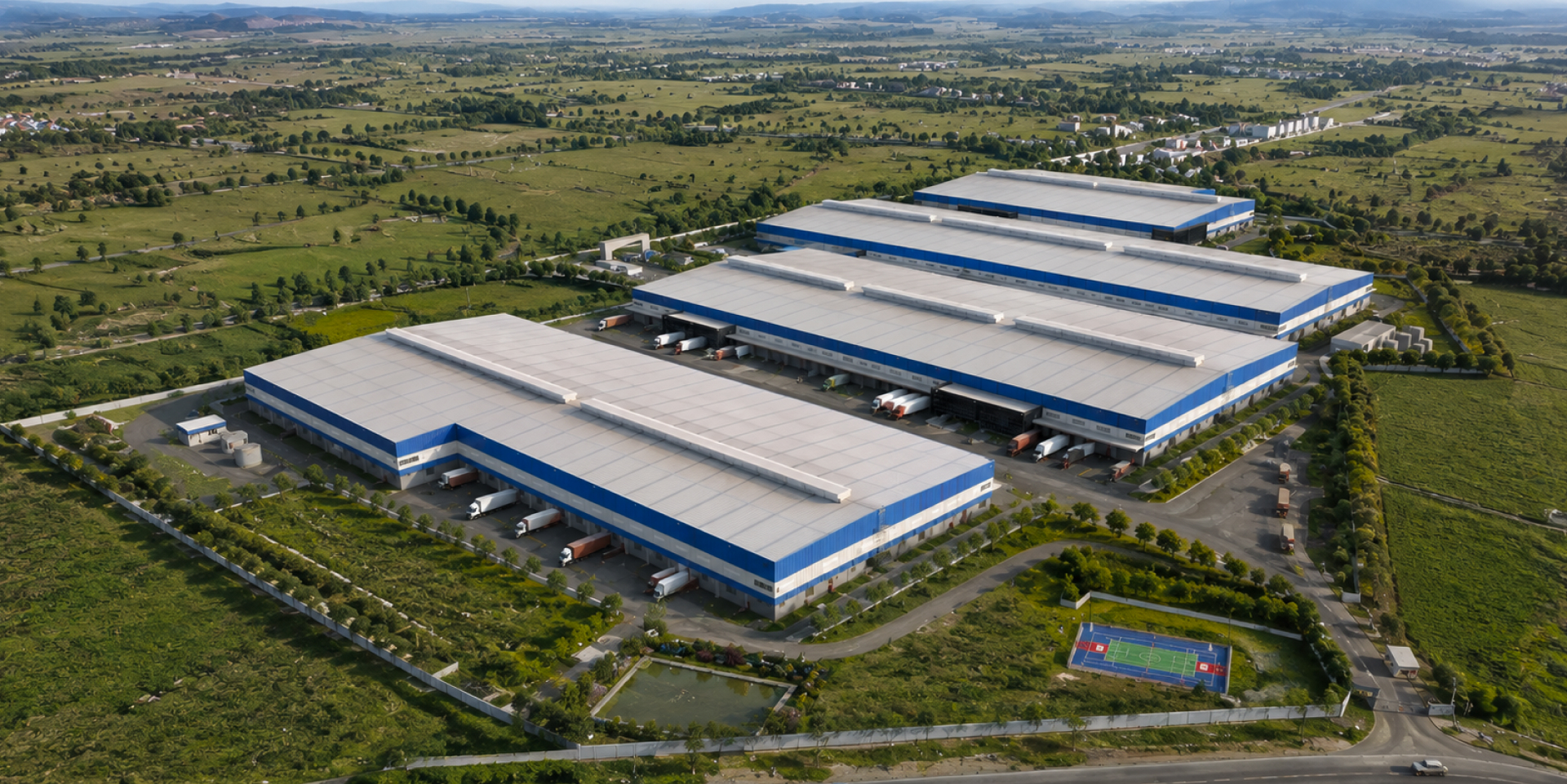


A built-to-suit (BTS) factory in India is a manufacturing plant designed and built by an industrial park developer to a tenant’s specific production requirements — layout, clear height, sanctioned power load, floor rating, utilities, fit-out — on land the developer owns, leased to the tenant under a long-tenure commercial contract. It is the format enterprise-grade manufacturers pick when their plant is non-standard, their customer horizon is a decade or longer, and their finance strategy favours preserving capital for machinery over real estate.
This playbook is written for MDs, CEOs, plant heads, project leads, and CFOs at automotive Tier-1s, EV players, electronics EMS, engineering, pharma, and FMCG manufacturers actively evaluating BTS as the format for their next India plant. It reflects how KSH INFRA — which develops and operates Grade A industrial parks and BTS facilities across Pune, Mumbai, Chennai and Bengaluru — structures the process internally. The framework applies whether you eventually build with KSH INFRA or another institutional developer.
What Built-to-Suit Actually Means (and What It Isn’t)
BTS is often confused with two adjacent product formats. Getting the definition clean is the starting point for any serious evaluation.
BTS is not a speculative building. A speculative (or “spec”) industrial building is one the developer constructs on assumption of future demand, with a standard specification. The tenant leases it as-is, sometimes with minor fit-out changes. BTS, by contrast, is designed for the named tenant against a signed brief before construction begins.
BTS is not a ready-built factory (RBF) or Standard Design Factory (SDF). RBF/SDF units are pre-built modular factory bays available for immediate occupation — designed for MSMEs and contract manufacturers who need plug-and-play space in weeks, not months.
BTS is custom plant real estate under a lease. You get the specification precision of a self-built factory without the land purchase, without the developer risk, and — critically — without the CapEx drag on your balance sheet. The developer holds the real estate risk. You hold the operational commitment through the lease.
The reason this distinction matters: it determines which developers you should even shortlist. Institutional-grade industrial park operators — KSH INFRA and its peer set — offer all three formats. Pure logistics-park landlords typically do not offer BTS for manufacturing at all.
When BTS Is the Right Call
BTS is not the right format for every tenant. Use it when at least three of the following are true:
- Your plant configuration is non-standard. You need clear heights above 12m, floor loads above standard industrial (5–8 t/sq m), specialised MEP systems, cleanroom bays, or utilities like process cooling, high-purity water, or industrial-grade compressed air.
- Your customer horizon is 10 years or longer. A signed OEM contract, a large export order book, or a PLI commitment justifies the long lease tenure BTS requires.
- You want to preserve capital for machinery and working capital. Machinery for EV, semiconductor, and pharma plants easily runs into hundreds of crores; tying up an additional ₹40–150 crore in land plus building shifts your return economics.
- You need speed to first production. A BTS on developer-owned, EC-approved land can begin construction within weeks of design freeze. A greenfield plot purchase in India typically takes 8–14 months before the first shovel goes in.
- You want the developer to carry real estate risk. Title, land aggregation, zoning conversion, environmental clearance, master infrastructure — the developer has already done all of it.
If fewer than three of these apply, evaluate an RBF or a plot purchase before defaulting to BTS.
The BTS Process, Month by Month
A typical BTS project inside a Grade A industrial park runs 12 to 18 months from signed term sheet to first production. Complex plants (semiconductor, EV cell manufacturing, pharma formulation) can run 20 to 30 months. The KSH INFRA process — representative of the institutional standard — moves through six phases.
Phase 1: Shortlisting and site walk-through (Month 0 to Month 1)
Two to four developers, three to five sites. Walk each site with your project head and utilities lead. Evaluate against the 12-point park-selection framework: location fit, sanctioned power, zoning, expansion, water and effluent, fire, approvals, subsidies, connectivity, talent, ecosystem, developer track record.
Phase 2: Brief and design (Month 1 to Month 3)
This is the highest-leverage phase in the entire project. Deliver a written space program (department-by-department square footage), a spec sheet (clear height, floor load, power load, utility loads, cleanroom class if applicable), and a Level of Development (LOD) map for the design.
Underinvest here and you pay in change orders later. KSH INFRA typically runs three to four working sessions with the tenant’s project lead during this phase before the design is frozen.
Phase 3: Commercial finalisation (Month 3 to Month 4)
Base rent, escalation, lock-in, exit clauses, fit-out contributions, security deposit, and utility connection charges all get locked in a term sheet, then converted to a Lease Deed. Do not skip legal counsel with industrial real estate depth here — the standard commercial real estate lawyer does not always catch industrial-specific traps.
Phase 4: Approvals and mobilisation (Month 4 to Month 5)
Building plan approval, Consent to Establish (CTE) from the state pollution control board, fire NOC, factory licence application, and if the park does not already have park-level environmental clearance, tenant-level EC. Institutional developers — KSH INFRA operates on this standard — build BTS facilities inside parks that already carry EC, so this phase is compressed.
Phase 5: Construction (Month 5 to Month 13, project-dependent)
Superstructure, MEP, fit-out. Your side needs a dedicated project lead in weekly review with the developer’s project management team. Change orders in this phase are the single largest source of cost and timeline overruns. Freeze the design in Phase 2, and this phase compresses.
Phase 6: Handover, fit-out, and first production (Month 13 to Month 16)
Handover involves snag list closure, utility commissioning, Consent to Operate (CTO), fire compliance certification, and factory licence issue. Machinery installation and trial runs then bring you to first production.
The Commercial Structures That Actually Matter
BTS lease economics are structured differently from a spec-building or RBF lease. Six variables carry most of the negotiation weight.
Base rent. Quoted in ₹ per sq ft per month on the built-up area. Rates vary by corridor, spec, and tenure — Western India Grade A BTS typically prices differently from South India, and specialised specs (cleanroom, cold storage, high floor load) carry premiums.
Escalation. The industry norm is a stepped escalation every three years — commonly 15% every three years, sometimes CPI-linked. For long-tenure leases (15 years or more), reset clauses become material.
Lock-in period. Institutional developers require a minimum lock-in — typically five to seven years — during which the tenant cannot exit without paying the full residual rent. This is what allows the developer to underwrite the BTS CapEx in the first place.
Fit-out ownership. Everything above shell-and-core is a negotiation. Standard base build usually excludes internal cleanroom construction, specialised process piping, industrial racking, and machinery-related civil work. Get this line-item allocated in the term sheet, not after.
Security deposit and utility connection charges. Deposits typically run three to six months of base rent. Utility connection charges — DISCOM deposit, water connection, gas — vary by state and are usually to the tenant’s account.
Ind AS 116 impact. Under Indian Accounting Standard 116, long-tenure operating leases capitalise onto the balance sheet as a Right-of-Use asset with a matching lease liability. Loop in your CFO and auditor in Phase 3 — not Phase 6.
What Tenants Get Wrong
Six patterns show up repeatedly on BTS projects across India:
- Rushing the brief. Teams spend eight weeks on developer selection and two weeks on the space program. The reverse produces better outcomes. Every hour spent in Phase 2 saves ten hours in Phase 5.
- Not baking in expansion optionality. Contract wins and PLI ramp-ups routinely require 30% to 50% capacity expansion within 36 months. Negotiate the right to lease adjacent built-up area or take an option on an adjacent plot at signing.
- Underspec’ing utilities. Adding 2 MVA of sanctioned power or an additional 100 KLD water allocation after construction is either impossible or prohibitively expensive. Spec for Year 5 demand, not Year 1.
- Treating the developer as a contractor. BTS works as a partnership. The developer knows the corridor, the approvals, the utility providers, and the local labour market better than the tenant does. Use that knowledge.
- Misaligned timelines. A customer contract that requires first production in Month 12 will not survive a BTS that hands over in Month 16. Anchor your BTS timeline to your customer milestone from Phase 1.
- Weak tenant-side governance. BTS is a 15-month project with hundreds of decisions. It needs a dedicated tenant-side project manager who owns the interface with the developer’s PM. Rotating the role or leaving it to the plant head as a part-time responsibility ends in overruns.
The Six Decisions to Lock Before You Sign
If your BTS decision is imminent, six items must be locked — in writing, in the term sheet — before signing:
- Program. Total built-up area, department split, and future expansion buffer.
- Specification. Clear height, floor load, sanctioned power, water and effluent allocations, fire class, cleanroom class if applicable.
- Timeline. First-production date, penalty for delay, force majeure carve-outs.
- Commercial structure. Base rent, escalation, lock-in, exit, sub-lease permissions.
- Fit-out allocation. Line-by-line clarity on what sits inside base build versus tenant scope.
- Governance. Weekly review cadence, change-order process, sign-off authority on both sides.
Get these into the term sheet and the rest of the negotiation runs smoothly. Leave them ambiguous and every subsequent conversation reopens them.
Frequently Asked Questions
How long does a built-to-suit factory take to deliver in India? A typical BTS factory inside a Grade A industrial park takes 12 to 18 months from signed term sheet to first production. Simple projects with pre-approved parks can compress to 10 months; complex plants (semiconductor, EV cell, pharma formulation) extend to 20 to 30 months.
Is BTS more expensive than buying industrial land and building your own factory? On absolute rupee outflow over a 15 to 20 year horizon, self-build on owned land can be lower. On capital efficiency (CapEx preserved for machinery, faster payback, no real estate risk, no exit friction), BTS is often better, particularly for manufacturers whose primary economic engine is machinery utilisation, not land appreciation.
Can I customise or expand the plant later? Yes, if the lease is written for it. Negotiate expansion optionality at signing — either the right to lease adjacent built-up area, or the right to take up an adjacent plot for further BTS. Retrofitting expansion after Year 3 is possible but expensive.
What happens if my customer contract falls through? The lock-in period protects the developer, not the tenant. If your business case changes, options include sub-leasing (only if the lease permits it), assignment to a group entity, or negotiated early exit against a settlement. These clauses need to be written into the lease upfront.
Who owns the building at the end of the lease? The developer. BTS is a lease, not a sale. However, some developers offer purchase options or renewal terms — negotiate these at Phase 3, not at lease-end.
Where in India can I get a built-to-suit factory? BTS is available across most active manufacturing corridors — Pune (Chakan, Ranjangaon), Talegaon, Hosur, Chennai (Sriperumbudur, Oragadam), and Bangalore (Hoskote, Nelamangala, Bidadi) are the most active for institutional-grade BTS work, along with Ahmedabad, Sanand, and select emerging corridors.
Next Steps
Shortlist two to three developers with genuine BTS delivery credentials in the corridor you have chosen. Ask each for reference calls with at least one tenant whose plant they delivered in the last three years — the reference call is where the developer’s actual behaviour on Phase 5 governance becomes visible. Send your space program and spec sheet to each, and evaluate their Phase 2 response quality before you evaluate their price.
Then, before you enter the term sheet, run a full total-cost-of-occupancy model over your intended lease horizon. Base rent is one line. Utility connection charges, subsidy net, escalation stack, fit-out allocation, and CAM together determine the actual number.


