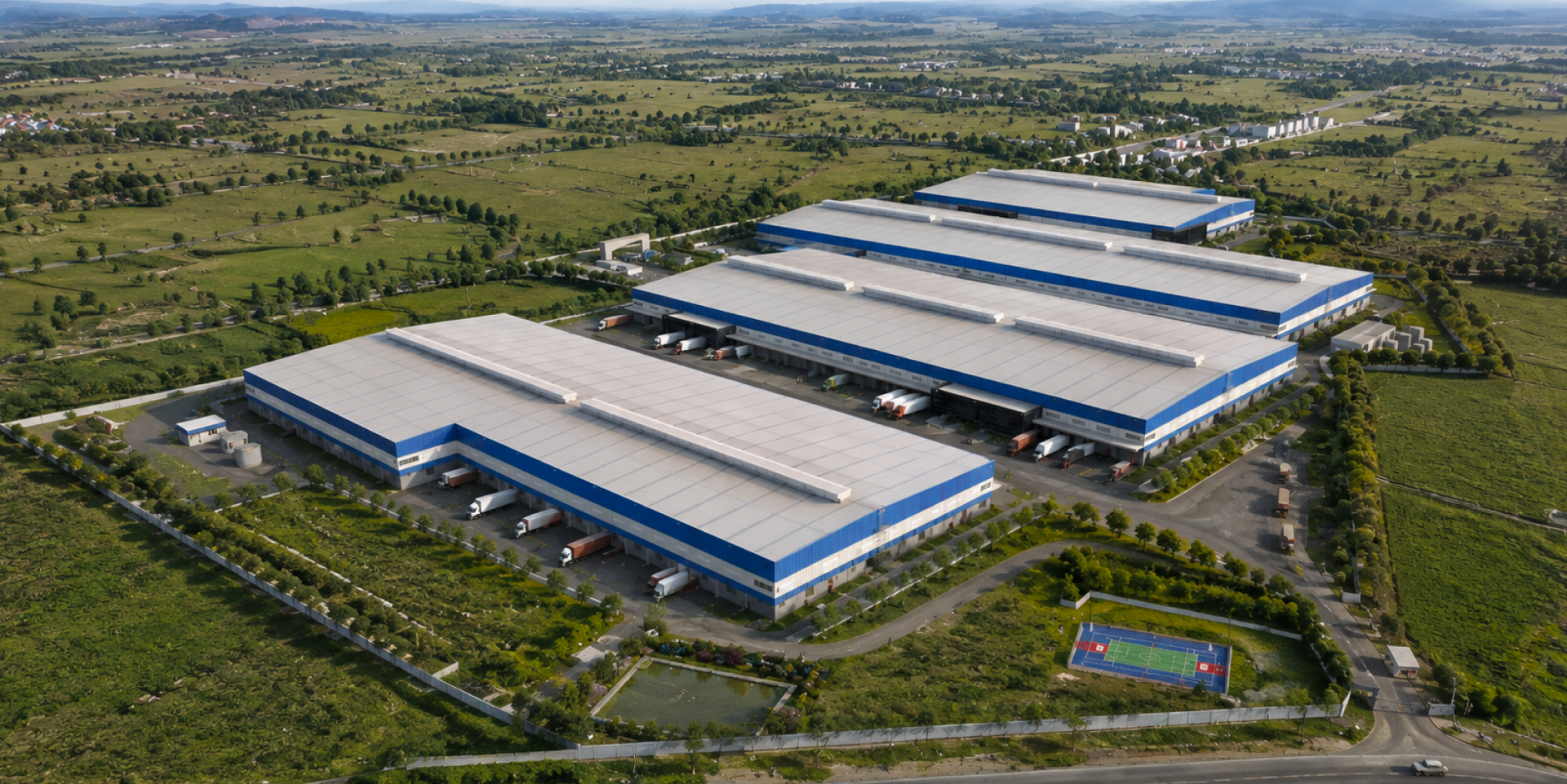


“Grade A” is one of the most overused terms in Indian industrial real estate. Developers claim it. Brokers repeat it. Buyers accept it — until a signed lease reveals a sanctioned power load 60% below what the operation needs.
Grade A is not a self-declared designation. It is a composite of twelve specifications, each with a measurable threshold, that together determine whether a park can support institutional-grade manufacturing over a 15- to 30-year horizon. This article covers all twelve — framed as the standard KSH INFRA applies internally when evaluating a park, and the standard a serious manufacturer should apply to any park under consideration.
The 12 Grade A Industrial Park Specifications Every Manufacturer Should Verify
- Sanctioned power load and supply reliability. Grade A Parks tie up industrial-grade power at the campus level — commonly through 33 kV or 66 kV dedicated substations — supporting tenant allocations typically ranging from 500 kVA to several MVA. The real specification is not the paper number; it is DISCOM uptime history and the park-level backup arrangement.
- Clear height. Grade A industrial buildings offer clear internal heights designed for modern plant layouts, overhead cranes where applicable, and material handling equipment. Thresholds vary by sector — EV cell manufacturing demands different heights than general engineering — but Grade A implies specs designed for current and next-generation operations.
- Industrial-grade floor loading. Floor load capacity, in tonnes per square metre, must match the heaviest static and dynamic loads your operation imposes — machinery, racking, forklifts, stored material. Request the structural design brief, not a verbal assurance.
- Column spacing and modular bay dimensions. Column-free spans and bay widths determine plant layout flexibility. Narrow spacing forces compromise in machinery placement and material flow. Grade A buildings favour wide-span structural design.
- Water availability and quality. Grade A Parks document the water source (municipal, state scheme, borewell), the per-tenant allocation in kilolitres per day, and water quality parameters. Pharma, food, textiles, and electronics tenants must verify both quantity and quality upfront.
- Effluent and waste management infrastructure. For effluent-generating tenants, Grade A Parks provide Common Effluent Treatment Plant (CETP) capacity with documented headroom. Hazardous waste arrangements under the Hazardous and Other Wastes Rules, 2016, are structured at park level rather than being left to each tenant.
- Fire safety per NBC 2016. The National Building Code of India, 2016, and applicable state fire service rules govern fire infrastructure. Grade A Parks maintain hydrant networks, sprinkler mains, fire tender access widths, and compartmentalisation that meet or exceed the code — with current fire NOCs on file.
- Heavy-vehicle access and internal road geometry. Internal roads must accommodate container trucks, trailers, and project cargo. Turning radii, carriageway widths, and gradient profiles separate Parks designed for industrial operations from Parks retrofitted from other uses. Read the layout drawings, not the entrance gate.
- Setbacks, FSI utilisation, and expansion ground. Floor Space Index (FSI) limits vary by state; Grade A Parks maximise usable FSI while complying with setback and open-space rules under applicable state and local regulations. Equally important: adjacent land or built-up area that lets tenants expand without relocating.
- Park-level statutory approvals. Grade A Parks hold layout approvals from the competent authority and, where applicable, park-level environmental clearance under the EIA Notification, 2006. Park-level approvals compress tenant setup timelines materially. Confirm which approvals are park-level and which remain tenant-level before signing.
- Common infrastructure and amenities. Grade A implies institutional operations — perimeter security, 24×7 access control, STP for domestic sewage, telecom and fibre redundancy, labour welfare facilities, and park management with defined SLAs. Institutional operators — KSH INFRA and its peer set — treat these as baseline.
- Multi-modal connectivity. Grade A Parks sit on infrastructure connecting to national and expressway networks, to the relevant port of export, and in some cases to rail sidings. KSH INFRA’s Parks in Pune, Talegaon, Hosur, Chennai, and Bangalore follow this logic — corridor proximity is itself part of the Grade A specification.
Why All 12 Grade A Specifications Must Be Met — Not Most of Them
A park that meets eleven specifications and misses one is not a Grade A park. It is a park with a specific vulnerability — and that vulnerability is what the manufacturer buys when they sign. A 2 MVA power shortfall constrains your production ramp. A CETP at 95% capacity delays your Consent to Operate. Missing expansion ground forces relocation when your customer contract scales. Grade A is a composite designation precisely because industrial operations have no slack.
Grade A Industrial Park Specifications: Frequently Asked Questions
Q. Is “Grade A” a formal certification?
No. Grade A is an industry classification based on composite specifications, not a certification issued by a regulatory body. Which is precisely why buyers must verify specifications independently rather than relying on the developer’s self-description.
Q. Do these specifications apply equally to warehousing parks and manufacturing parks?
The categories overlap significantly, but manufacturing parks place greater weight on sanctioned power, water and effluent, and modular bay dimensions, while warehousing parks place greater weight on clear height, dock design, and truck court depth. Verify specifications against your specific operational profile.
Q. How do I verify these specifications before signing?
Request documented evidence — DISCOM sanction letters, water allocation orders, CETP capacity records, structural design briefs, approved layouts, fire NOCs, and park-level environmental clearances — not verbal assurances. Walk the site with your project head and utilities lead. Speak to at least two existing tenants.
How to Evaluate a Grade A Industrial Park Against the 12 Specifications
Apply the twelve-specification framework to every park on your shortlist. Score each park on each dimension against the needs of your specific operation. The parks that score consistently high across all twelve are the ones worth pursuing; parks that score high on nine or ten and vague on the rest are the ones that produce the post-signing problems this article is written to prevent.
Head Office
Gokhale Sanchit, Office No. 4, Survey No. 846,
Servants of India Society, Near Marathwada College,
Shivajinagar, Pune, Maharashtra – 411 004 (India)
Call Us: +91 20 2970 4000.
Email: [leasing@kshinfra.com]
Visit: [www.kshinfra.com]
Let’s build the future of industry…together!


