
Hosur’s industrial base is not simply growing; its composition is changing. Electric vehicle (EV) supply chains run on different economics from the ICE supply chains that built the corridor, and those differences show up directly in what manufacturers ask of an Industrial Park. Developers often see this shift first in tenant briefs, well before it appears in market data.
At KSH INFRA, which develops Grade A Industrial Parks in Chakan, Talegaon, Hosur and near Sriperumbudur, those briefs have changed noticeably in recent years, and four structural shifts stand out. This article sets out each one and what it means for site selection. The framework applies whether you are shortlisting a KSH INFRA Park or any other developer’s.
From ICE to EV: How Hosur’s Automotive Supply Chain Is Compressing
The ICE supply chain that built Hosur is wide and layered: an OEM at the top, Tier-1 suppliers below it, and a deep base of Tier-2 and Tier-3 sub-component makers. It tolerated distance. Components were comparatively simple to transport, product cycles were long, and suppliers could sit well outside the immediate corridor and still serve an OEM reliably.
EV supply chains are typically flatter. Tier-1 suppliers to EV OEMs tend to integrate more of the value chain, including power electronics, battery management systems, motors, and thermal management, into fewer and larger operations. For industrial real estate, that means demand increasingly arrives as fewer tenants with bigger footprints and heavier utility and compliance needs, rather than many small fabricators taking standard units.
| Factor | Legacy ICE supply chain | EV supply chain |
| Tier structure | Many tiers, wide supplier base | Fewer tiers, more vertical integration |
| Typical tenant profile | Many smaller units | Fewer, larger operations |
| Utility demand | Moderate, standard industrial | Higher loads, sensitive to supply quality |
| Fire and safety scope | Standard industrial fire compliance | Lithium-ion risk adds specialised protocols |
| Distance tolerance to OEM | Relatively high | Lower; proximity carries more value |
| Preferred facility format | Plot plus standard shed | Ready-built or built-to-suit |
These are generalised patterns. Individual companies, products, and sub-sectors vary.
Three EV Manufacturing Requirements Now Shaping Industrial Parks in Hosur
- More power, and cleaner power. Battery testing, motor dynamometer cells, charging infrastructure for vehicle validation, and controlled-environment air handling generally push sanctioned loads above what legacy auto-component operations needed. Supply quality matters as much as quantity: voltage stability, harmonics, and outage history affect sensitive test and electronics equipment. In Hosur, that makes the conversation with the state distribution utility, and the park’s documented supply record, part of site selection rather than an afterthought.
- Fire and safety built for lithium-ion risk. Part 4 (Fire and Life Safety) of the National Building Code of India, 2016, and the requirements of Tamil Nadu Fire and Rescue Services form the baseline. Cell, pack, and battery-testing operations typically add thermal runaway containment, suppression systems suited to battery fires, and insurer inspections on top. A Park’s fire NOC is a starting point; confirm that it covers the activity you will actually run. Battery and chemical processes can also change a facility’s consent category with the Tamil Nadu Pollution Control Board (TNPCB), so check that the park’s environmental approvals can accommodate your process.
- Specialised bays inside the building. Dry rooms for cell work, EMI-shielded rooms for electronics validation, dyno cells for motor testing, and climate-controlled bays for battery cycling are tenant fit-outs, but they place demands on the base building: floor loading, clear height, roof capacity for HVAC plant, and column spacing. These are among the Grade A industrial park specifications worth verifying in writing before a specialised fit-out is designed.
Why OEM Proximity Matters More in Hosur’s EV Supply Chain
EV supply chains reward short distances for three reasons. First, lithium-ion batteries are classified as dangerous goods for transport, and packs are heavy and high-value, so transport cost and risk rise quickly with distance. Second, EV programmes tend to run faster engineering iteration cycles, and physical proximity shortens design feedback loops between OEM and supplier. Third, cell-to-pack-to-vehicle sequences often run on tight just-in-time schedules that long-haul supply struggles to support.
The practical result is that EV suppliers tend to place more value on being close to their anchor OEMs within the Hosur–Krishnagiri belt than legacy ICE Tier-2 suppliers historically did. When comparing parks, measure actual route time to your anchor customer and key suppliers at shift-change hours, not straight-line distance. For context on how the wider corridor is developing, see Hosur’s industrial surge and the Hosur–Chennai industrial corridor.
Built-to-Suit and Ready-Built: How Hosur Industrial Leasing Is Shifting
For decades, the dominant Hosur pattern was to acquire a SIPCOT or private plot, build a standard shed, and operate from it for the life of the OEM relationship. For EV-linked tenants, that pattern is giving way to leased formats from institutional developers, for three reasons: EV specifications rarely fit speculative sheds, capital is usually better deployed in battery and motor machinery than in land and construction, and leasing can reduce the time between investment decision and production start.
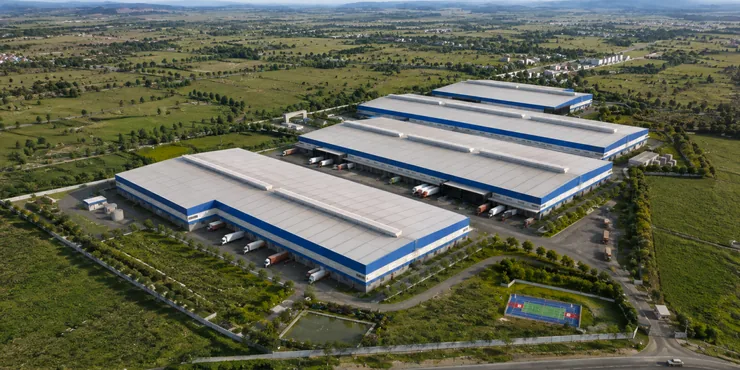
The two leased formats serve different needs. A built-to-suit factory suits operations that need dry rooms, test cells, or non-standard structural loads. Ready-built space, such as the plug-and-play industrial parks model, suits assembly, warehousing, and component operations that can start in a standard Grade A building. Many tenants combine the two, starting in ready-built space while a larger custom facility is planned. KSH Hosur Park I, for example, is a 1.26 million sq ft park of four pre-engineered buildings with 9 to 12 metre building heights, roofs designed for solar, and built-to-suit office space. Whatever developer you shortlist, the question is the same: can the Park support both your day-one operation and the specialised expansion that may follow?
Plotted-land demand has not disappeared. The shift is in what the largest and most specification-heavy enquiries now look for.
How to Shortlist an Industrial Park in Hosur for EV and Auto-Component Manufacturing
Grade A specifications remain the baseline. For EV-linked operations, add these checks and ask for documents rather than verbal assurances:
- Power: sanction letters showing available headroom, plus the Park’s supply quality and outage record.
- Fire safety: fire NOC scope matched to your actual process, and your insurer’s requirements for lithium-ion operations.
- Environmental approvals: whether the Park’s clearances and TNPCB consent position can accommodate battery or chemical processes.
- Building capacity: floor loading, clear height, and roof capacity for specialised bays and HVAC plants.
- Format flexibility: the developer’s built-to-suit delivery record and the availability of expansion land or adjacent buildings.
- Location: measured route times to anchor OEMs and key suppliers.
Walk shortlisted sites with your project head, utilities lead, and a supply chain manager who can map inbound and outbound logistics. A structured approach to auditing an industrial park before you sign covers the legal, title, and approvals side of the same decision. If your programme also includes power electronics or control units, the electronics and EMS manufacturing in Hosur site-selection view covers the additional checks those operations need.
Hosur EV Supply Chain and Industrial Real Estate: Frequently Asked Questions
Why is EV manufacturing changing industrial real estate demand in Hosur, not just growing it? EV supply chains typically have fewer tiers, larger operations per supplier, higher power and safety requirements, and lower tolerance for distance from the OEM than legacy ICE supply chains. That changes the type of space manufacturers need, not only the amount.
Are legacy automotive industrial parks in Hosur still relevant? Yes. They continue to serve ICE components, aftermarket, engineering, and lower-utility operations. Parks that cannot support higher power loads, lithium-ion fire protocols, or built-to-suit arrangements may, however, be passed over by the largest EV-linked tenants.
What should EV suppliers look for in an industrial park in Hosur? Beyond Grade A specifications: documented power headroom and supply quality, fire approvals that cover lithium-ion activity, environmental consents that fit the process, building capacity for specialised bays, built-to-suit and expansion options, and short route times to anchor OEMs.
Is built-to-suit or ready-built space better for an EV supplier in Hosur? It depends on the process. Ready-built space suits assembly, warehousing, and component operations that need to start quickly. Built-to-suit suits operations needing dry rooms, test cells, or non-standard structural loads. Many suppliers use ready-built space first and add a built-to-suit facility as volumes grow.


